

- Keep a record of every brand contact and every project from day one. A simple file of who you worked with, what you made and what you were paid becomes your portfolio, your referrals and your pricing evidence.
- Do your admin every week, not every January. HMRC asks the self-employed to keep records for at least five years after the 31 January filing deadline, and from April 2026 Making Tax Digital applies to sole traders with income over £50,000.
- Protect the work until you are paid: send watermarked previews, ask for half up front and the rest on delivery, and know that UK law lets a business supplier charge statutory interest on late payment.
- Put every project in writing, especially with apps and online services where no product changes hands. Copyright in your video stays yours unless you assign it in a signed document, so the contract should say exactly what the brand may do with it.
- Make a wider range of content and show it on a website you own. Platforms change their rules; your own site does not.
Where these lessons come from
UGC began as the term for anything ordinary people posted online: reviews, photos, comments, forum posts. Brands value it because it feels honest and earns trust. Over the last few years the word has also come to mean a job. A UGC creator is someone a brand pays to make content in that natural, customer style, usually short videos for the brand's own channels and adverts, rather than for the creator's own followers. Our guide to what UGC is explains the difference in full.
Velena started out as one of those creators, answering brand messages from her phone and filming in whatever light the day allowed. In January 2024 she wrote down the things she would do differently if she started again. That piece was personal and short. This version keeps every lesson from it, tells them as our own early experience, and adds what we have learned since, now that our team makes UGC for brands every week and hears from new creators who are where Velena was.
It is written mainly for people starting out as UGC creators in the UK. If you are a brand, the last section is for you: every lesson here has a mirror image, and the brands that understand it get better work and better creators.
None of what follows is legal or tax advice, and we are a content agency, not accountants or solicitors. Where we mention a rule, we link to the official source so you can check it, and for anything that affects your own money or a contract you are about to sign, speak to a qualified adviser.
Lesson one: keep every contact, from the first email

The first thing Velena would change is how she kept track of the brands she spoke to. In the early days, contacts lived in email threads and direct messages, and when a conversation went quiet it was easy to lose it altogether. If she started again, she would keep every client email address she had ever been in contact with, in one place, with a note of what was discussed, so she could reach out again later and build long-term relationships rather than one-off jobs.
That file does more than help you follow up. It is a record of who you have worked with and what you made for them, which helps you show your portfolio, ask for referrals and negotiate better rates, because you can see what you charged last time and what the work involved. Over a year or two it also shows you which kinds of brand come back and which never do, and that tells you where to spend your time.
Keep it simple. A spreadsheet with a row per brand is enough: the brand, the contact's name and role, how you met, what you made, the date, the fee, whether they paid on time, and a note for next time. Add a column for "follow up on" with a date, and look at that column once a week.
One thing has become more important since 2024: these are other people's personal details, and data protection law applies to them. The ICO's guidance on business to business marketing says that a named contact at a business is still personal data under UK GDPR, so you need a lawful basis to keep it, should tell people how you use it, and must respect anyone who asks you to stop contacting them. It also says that sole traders and partnerships are treated like individuals for marketing emails, which generally means you need their consent. In practice: keep only what you need, store it securely, do not add people to a mailing list without asking, and delete a contact who asks you to.
Lesson two: do the admin every week, not every January
The second lesson is about money. In the early days, payments arrived through different routes, gifted products arrived alongside them, and receipts went wherever receipts go. Velena would now keep a file of every transaction from the first one, and do the admin at least once a week. It takes twenty minutes when you do it weekly and whole days when you leave it for the end of the year, when the tax return is due and the earnings have to be reported.
The rules make this more than good housekeeping. HMRC's guidance on business records if you are self-employed says you must keep your records for at least five years after the 31 January submission deadline of the relevant tax year. If you file your 2025 to 2026 return by 31 January 2027, that means keeping the records until at least January 2032.
Three more rules catch new creators out:
Making Tax Digital is the reason we would now start with accounting software, or at least a spreadsheet that compatible software can read, rather than a notebook. Qualifying income is your gross self-employment and property income before expenses, so a successful creator can cross the line faster than they expect. Set up digital records from your first invoice and the change will barely touch you.
Your weekly admin can be as short as this: log every payment and every gifted product with its value, save every receipt for equipment, software and travel, send any invoice that is due, chase any that are overdue, and update the contact file from lesson one. If you want to understand how the structure you trade through affects what you keep, our report on graduating into the creator economy models it in detail.
Lesson three: protect the work until you are paid

This is the lesson that cost the most to learn. Velena has been in situations where she sent the finished files to a client and then waited a week to be paid. Worse, some clients disappeared once they had the files and never paid at all. It was frustrating and unfair, and it meant the time and effort that went into the work were simply lost.
If she started again, she would do two things from the very first project. First, send the work with a watermark, and only send the clean files once the money is in the bank. A watermarked preview lets the brand review the edit, ask for changes and approve it, without being able to publish it before paying. Second, ask for half of the fee before starting, and the other half on delivery. The deposit means at least part of the work is paid for whatever happens, and it gives the client a reason to finish the job properly.
Both are ordinary practice in creative work, and a serious brand will not be offended by either. Put them in your rate card and your first email, so they are expected rather than a surprise. A few details make them work better:
- Make the watermark visible but not uglyA semi transparent name across the middle of the frame, or a low resolution preview, is enough. The brand needs to judge the edit, not publish it.
- Agree the number of revisionsSay how many rounds of changes the fee includes before you start, and what counts as a change rather than a reshoot. Our article on the cost of easy content explains why "one small edit" so often is not.
- Put payment terms on the invoiceState the amount, the due date and how to pay. A clear invoice is paid faster than a vague one.
- Know your rights on late paymentGOV.UK explains that a supplier can charge statutory interest on a late commercial payment of 8 percent plus the Bank of England base rate, unless the contract sets a different rate, and can also claim a fixed sum for recovery costs: £40 on a debt under £1,000, £70 up to £9,999.99, and £100 above that.
You may never need to charge statutory interest, but knowing it exists changes how you write a chasing email. A polite reminder that mentions the due date and your right to interest under the Late Payment of Commercial Debts (Interest) Act 1998 is usually all it takes. And if a brand refuses a deposit, refuses watermarked previews and wants the files before paying, that tells you something useful about how the rest of the project will go. Our article on UGC scammers covers the warning signs.

Lesson three, continued: put every project in writing
The old version of this article put contracts inside the lesson about getting paid. We have given them their own section, because they matter more than anything else here. Velena would now work with contracts much more often, and especially with brands that do not send any product, such as apps and online services. When a skincare brand sends a parcel, there is at least a physical record that a deal exists. When an app asks for a video, there is nothing but a message thread, and it is the easiest kind of work to leave unpaid.
A contract protects both sides. It sets out the scope of the work, the timeline, the standard expected, the fee, how and when it is paid, and what happens if either side wants to change something. And it settles the question that matters most in UGC: what the brand may do with the video once it has it.
That question is about copyright. Under UK law, the person who creates a video normally owns the copyright in it. Section 90(3) of the Copyright, Designs and Patents Act 1988 says an assignment of copyright "is not effective unless it is in writing signed by or on behalf of the assignor". In plain terms, a brand does not own your video just because it paid for it. What it gets is a licence, a permission to use the video, and the contract should say exactly what that licence covers: organic posts only, or paid adverts too; which platforms; for how long; and whether the brand may edit it.

This is why advert rights are priced separately from the video itself across the UGC industry. Our guide to UGC rates in the UK explains how usage and licence length change the price, and the free UGC rate calculator prices the video and the rights as separate lines.
Two newer rules belong in the contract too. If the content will be published as a review or testimonial, the Digital Markets, Competition and Consumers Act 2024 matters: since 6 April 2025, as the ASA's guidance on fake consumer reviews explains, marketing must not contain fake consumer reviews, meaning reviews that claim to be based on a genuine experience but are not. Only film a testimonial for a product you have actually used. And if you post sponsored or gifted content on your own channels, the ASA's influencer guidance says gifted products count as payment in kind and the post must be labelled as an ad.
Velena's view in 2024 was blunt: if a brand does not want to give you a contract, it is not serious enough about its work or yours, and you probably do not want to work with it. We still agree. A short, clear agreement is not a sign of distrust. It is what professionals on both sides expect.
Lesson four: more variety, and a portfolio you own

The last lesson is about how you show your work. In the early days, Velena's examples lived mostly on social platforms and in links sent one by one. If she started again, she would make a wider variety of UGC sooner, and send it to brands through a portfolio on a website she paid for and controlled.
Variety matters because brands buy different things. One wants a talking to camera testimonial, another an unboxing, another a product demonstration with a voiceover and no face at all, another a day in the life. The 2024 version suggested experimenting across videos, podcasts, blogs and infographics too, and the principle still holds: every new format you can show is a new kind of brief you can win. Our UGC examples guide walks through the formats brands ask for most.
Owning the portfolio matters because platforms change their policies, their algorithms and their fees, and an account can be restricted overnight. A website on your own domain is the one place where you decide what is shown and how. Keep it simple: a short introduction, the niches you work in, six to twelve of your best videos grouped by format, a few words about what each brand asked for, testimonials from clients who have agreed to be quoted, and a clear way to contact you. Update it every few months, and take down anything that no longer represents your best work.



A good portfolio does quiet work for you. It answers the questions a brand would otherwise ask in three emails, it shows your range at a glance, and it makes you easier to find when someone searches for a creator in your niche. Testimonials and short case notes from past clients build credibility faster than anything you say about yourself.
A checklist for new UGC creators
If you are just starting, this is the list we wish Velena had been handed on day one. Our companion guide, UGC for beginners, covers choosing a niche and reaching out to brands.
- Start a contact file todayOne row per brand, with the date, the work, the fee and a follow up date. Keep it secure and keep only what you need.
- Open a separate bank accountBusiness money in one place makes the weekly admin, and the tax return, far simpler.
- Log gifts with a valueHMRC counts them as income. Note the product, the brand, the date and roughly what it would sell for.
- Write a rate card and termsPrices, what is included, revisions, a 50 percent deposit, payment on delivery, and usage rights priced separately.
- Use a simple contract every timeScope, timeline, fee, payment terms, revisions and exactly what the brand may do with the video, for how long.
- Send watermarked previewsClean files go out when the final payment arrives.
- Build a portfolio on your own siteGrouped by format, updated every few months, with a clear way to contact you.
- Book a weekly admin slotTwenty minutes, the same time each week: payments, receipts, invoices, chasers and follow ups.
What brands can learn from these lessons
Every lesson above has a mirror image for the brand. The creators who learned them the hard way remember which clients made them necessary, and which made them unnecessary. If you commission UGC, being the second kind of client gets you better work, faster, from creators who want to work with you again.
If you would rather not manage creators at all, our team makes UGC in house, and you choose who is on camera: Velena, Dragos, both, or nobody, with a voiceover. Every package states its price and the rights included on its page, and nothing is filmed until you have approved the brief.



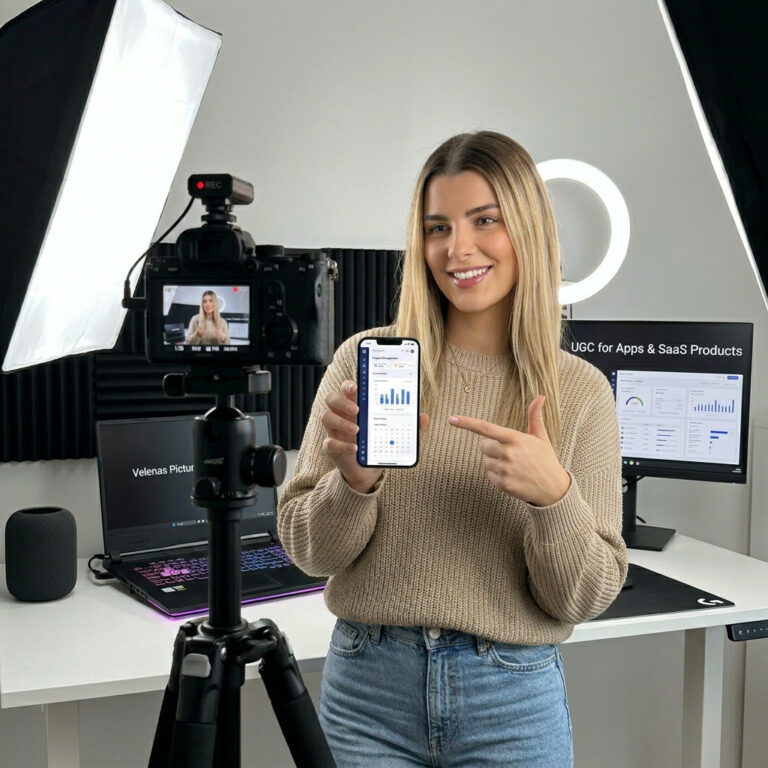
Lifestyle is one of twelve ranges, from beauty and fashion to apps and software, each with the same four packages. If you are still deciding between UGC and working with an influencer, our comparison of UGC and influencer marketing sets out when each one fits.
Starting out in UGC: questions
Should UGC creators ask for a deposit?
Yes. Asking for half of the fee before you start and the rest on delivery is ordinary practice in creative work. It means part of your time is paid for whatever happens, and serious brands expect it.
Should I watermark UGC before the brand pays?
It is a sensible habit. A watermarked or low resolution preview lets the brand review and approve the edit without being able to publish it. Send the clean files when the final payment arrives.
Who owns a UGC video, the creator or the brand?
Under UK law the creator normally owns the copyright, and an assignment only takes effect in a signed written document. Usually the brand buys a licence instead, so the contract should say where, how and for how long the brand may use the video.
Do I have to pay tax on gifted products?
HMRC's guidance for content creators says you must include the value of gifts or services you received for promoting products. Gifts count towards the £1,000 trading allowance, and above it you register for Self Assessment.
How long should I keep my records?
HMRC says the self-employed must keep records for at least five years after the 31 January submission deadline of the relevant tax year. Digital records make this easy and prepare you for Making Tax Digital.
What can I do if a brand pays late?
Send a polite reminder with the invoice and due date. Between businesses, UK law allows statutory interest at 8 percent plus the Bank of England base rate, unless your contract sets another rate, and a fixed recovery sum of £40, £70 or £100 depending on the size of the debt.
Do I need a website for my UGC portfolio?
It is not required, but it is the one place you control. Platforms change their rules and accounts can be restricted; a simple site on your own domain shows your best work by format and makes you easier to find.
Can I keep brand contacts in a spreadsheet?
Yes, but they are personal data. The ICO says named business contacts are covered by UK GDPR, so keep only what you need, store it securely, do not add people to marketing lists without consent, and remove anyone who asks.
- GOV.UK, Business records if you are self-employed: how long to keep your records
- HMRC, Tax help for hustles: tax rules for content creators
- GOV.UK, Tax-free allowances on property and trading income
- GOV.UK, One year until Making Tax Digital for Income Tax launches
- GOV.UK, Late commercial payments: charging interest
- GOV.UK, Late commercial payments: claim debt recovery costs
- legislation.gov.uk, Copyright, Designs and Patents Act 1988, dealings with rights in copyright works
- ICO, Business-to-business marketing
- ASA, Fake consumer reviews
- ASA and CMA, Influencers' cheat sheet
A question this article did not answer? Ask our team, and a person will reply.